By Matt Nash, Founder, Just Seal It. 20+ years on-site. 15,000+ surfaces sealed. Featured on The Block. Published 13 May 2026.
Marble pavers and tiles make a significant visual statement outdoors. They also make a significant maintenance commitment. Sealed correctly from the start, they hold their appearance for decades. Left unsealed, they absorb moisture, develop dark staining along grout lines, and become progressively harder to clean. The Natural Stone Institute provides independent reference on this.
The main complication with marble specifically is calcium carbonate. Marble contains it in high concentrations. Calcium carbonate reacts chemically with acid. That means the wrong cleaner, applied once, can permanently damage a surface a marble tile sealer would have protected for years.
Short version: All outdoor marble pavers, tiles, steps, pool coping, and facade stone should be sealed regardless of finish. Clean with Stone Wash diluted 1:100 only. Never acid. Apply two undiluted coats of Classic Sealer wet-on-wet between 10-30 degrees C. Allow 24 hours before furniture, 30 days before full chemical cure. Reseal fully every 3-5 years.
Why marble pavers and tiles need sealing

Most outdoor stone is silica-based: granite, bluestone, sandstone. These materials are relatively tolerant of the cleaning products homeowners reach for most often and respond well to standard penetrating sealers.
Marble is not silica-based. It forms from limestone under heat and pressure, which creates the characteristic veining and one critical weakness: high calcium carbonate content.
Calcium carbonate reacts with acid. That includes organic acids from leaf litter and garden beds, the mild acid in rainwater, and any cleaner with a pH below 7. When acid contacts marble, it does not leave a stain. It removes the surface layer of the stone chemically. This process is called etching. Etching is permanent. It presents as a dull, cloudy patch and cannot be cleaned away. Grinding and repolishing is the only remedy, and that is an expensive correction.
Outdoor marble also faces UV exposure and temperature cycling that indoor surfaces do not. Both accelerate surface wear. Both amplify the absorption of contaminants into any unsealed pore structure.
Moisture moving through unsealed marble carries dissolved mineral salts. As it evaporates, those salts crystallise inside the capillary structure. The crystals expand and contract with temperature changes, forcing the pore walls apart from within. That is the second mechanism of structural surface degradation in outdoor marble, alongside the acid etching risk.
The answer to all of this is a penetrating marble tile sealer applied to a clean, dry surface before the marble sees its first season of outdoor exposure. Applied correctly, the sealer penetrates the pore structure and provides effective protection, with a full reseal every 3-5 years outdoors.
Picture framing: the warning sign you need a marble sealer

Picture framing is the most common visible sign that outdoor marble tiles are unsealed or undersealed. If you have seen it, you know exactly what it looks like: a dark border running around the edge of each tile, tracing the grout line, while the centre of the tile looks clean.
What causes it is straightforward. The cut face of a marble tile, where it meets the grout joint, is more exposed than the top surface. Moisture, soil, and organic material enter the stone through the grout joint and travel into the porous stone along the edge. On unsealed marble, those contaminants are absorbed and held. The result is permanent dark staining along the tile perimeter.

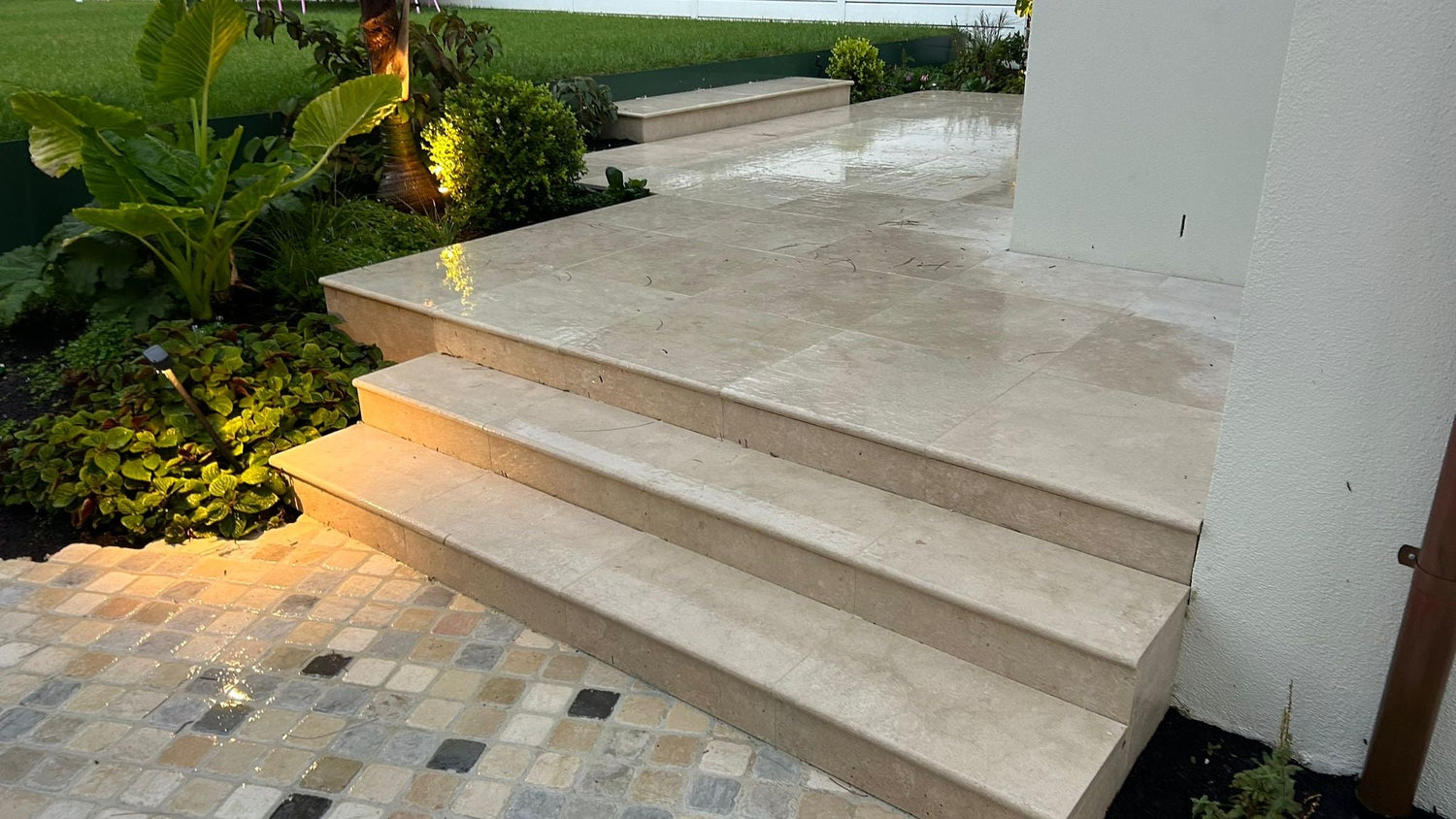
On light-coloured marble, which includes most cream, beige, and white varieties commonly used for terraces and entrance areas, picture framing becomes obvious within one or two years of outdoor exposure.
A penetrating sealer prevents picture framing by filling the pore structure across the full tile surface, including the cut edges exposed at grout joints. With the pores saturated and bonded with sealer, there is no pathway for moisture to enter the edge zone. The protection works from inside the stone, not as a film on top of it.
If picture framing has already developed, sealing alone will not reverse it. The staining is absorbed into the stone. Strip with a heavy-duty stone cleaner, allow to dry completely, then reseal. In advanced cases, professional stone restoration is required before resealing is effective.
The reliable way to avoid this entirely is to seal marble tiles before outdoor exposure. Do it once, correctly, and a full reseal every 3-5 years keeps it performing.
Does your marble actually need sealing
For outdoor marble, the answer is yes, regardless of finish. UV exposure, temperature cycling, rain, and organic acids from the garden work on any unsealed porous mineral surface. There is no outdoor marble that benefits from being left unsealed.
For indoor marble, finish matters more. Polished marble has a mirror-like surface produced by grinding and buffing. This process closes the pores significantly. Some highly polished indoor marble is dense enough to resist moisture without a sealer. Run the water absorption test to check: pour a small amount of water on the surface. If it absorbs and darkens within five minutes, seal it. If it sits on the surface without absorbing, the marble may be performing adequately without one.
Honed marble has a flat, matte finish. More porous than polished. Absorbs liquids faster. Sealing is strongly recommended for any wet area application or outdoor use.
Tumbled or antiqued marble has an intentionally rough, aged surface. It is the most porous finish of the three and will show picture framing and surface staining quickly without a sealer, particularly outdoors.
Outdoor marble, including tiles, pavers, pool coping, steps, and facade stone, should always be sealed regardless of finish. This is not a conditional recommendation.
How to clean marble pavers before sealing

Sealing over a dirty surface prevents the sealer from penetrating fully. But on marble specifically, the cleaner you use can cause damage that no sealer will fix afterwards.
Do not use anything acidic on marble. Vinegar, citrus-based cleaners, bathroom descalers, tile acid, grout removers: all of these will etch marble. The damage is a permanent surface-level chemical change. No amount of cleaning or sealing will reverse it.
Use Stone Wash diluted 1:100. It is pH-neutral, safe for calcium carbonate surfaces, and removes general grime, mineral deposits, soil staining, and organic buildup from outdoor marble. Apply with a stiff brush, scrub the surface and grout lines, rinse thoroughly with clean water.
If there is visible biological growth including algae, lichen, or mould, apply a sodium hypochlorite solution first, rinse well, then follow with Stone Wash to neutralise the pH. Do not leave sodium hypochlorite on marble longer than necessary and rinse before it dries.
The surface must be bone dry before applying any sealer. On outdoor marble in cool or overcast conditions, that can be 24-48 hours after cleaning. There is no fixed number. Press the back of your hand firmly to the surface in several spots. If it feels cold or damp anywhere, wait. Sealing damp marble traps moisture inside the stone and leads to efflorescence and surface clouding that is difficult to reverse.
See the How to Clean and Seal Guide for the full surface preparation process.
How to apply marble tile sealer

Apply in temperatures between 10-30 degrees C. Below 10 degrees C the sealer chemistry does not cure correctly. Above 30 degrees C the sealer can dry before it penetrates properly. Both conditions produce underperformance.
Test in an inconspicuous area first. Apply a small amount, wait 24 hours, and check for any colour change. Different marble absorbs at different rates. The test patch confirms compatibility and tells you whether two or three coats are needed.
Use a low-pressure pump sprayer or a microfibre applicator. Do not use a roller. Rollers create uneven application on natural stone. Apply the first coat moving left to right. Immediately apply the second coat in the opposite direction while the first coat is still wet. This wet-on-wet method ensures even coverage and correct penetration depth.
Do not let the sealer pool or puddle on the surface. Wipe any excess with a clean cloth before it dries. Pooled sealer will dry as a visible film on the surface.
For very porous marble including tumbled or heavily weathered surfaces, a third coat applied the same way gives complete coverage. For most honed and polished marble, two coats are sufficient.
Classic Sealer covers 10m2 per litre. For poolside marble, coastal-facing facades, and exterior marble exposed to significant moisture, Plus Sealer provides additional resistance to salt and moisture cycling. See the Sealants Specification Sheet for product-to-surface matching.
After application: light foot traffic 1-2 hours after the surface is dry to touch, furniture placement after 24 hours, full cure including cleaning chemicals after 30 days. After 30 days the sealer is part of the marble, not a layer on top of it.
How long does marble sealer last outdoors

Most stone used for paving is silica-based. Penetrating sealers bond with silica at a chemical level, which is why they perform so durably on granite, bluestone, and sandstone. Marble is different. It is calcium carbonate, not silica. Without silica to bond to, the sealer penetrates the pore structure and protects effectively, but it does not form the same long-term chemical bond.
On marble, expect to reseal fully every 3-5 years outdoors. Not a light maintenance coat. A full clean, bone dry, two fresh coats applied wet-on-wet. Pool surrounds and high-traffic terraces benefit from the 3-year end of that range. Marble steps and garden pathways in lower-traffic areas can go longer. See the Maintenance Guide for surface-specific timelines.
For most surfaces, a maintenance coat every 3 to 5 years is the right interval. Pool surrounds and high-traffic terraces benefit from the 3-year end of that range. Do not rely on surface appearance alone. Marble can look fine and still be unprotected. If you are unsure whether a coat is due, email us with a photo.
Three to five years on from the original seal: marble that has been resealed on schedule cleans up easily, holds its natural colour, resists picture framing and edge staining. Marble that has not usually looks visibly worse and costs significantly more to restore.
What not to use on marble
The most common mistake with marble sealing is using a topical sealer. Topical sealers sit on top of the stone as a film. They can look good for the first season. Then they trap moisture, yellow, and eventually peel, particularly outdoors where UV exposure and temperature cycling work on the film continuously. Removing a failed topical sealer from marble requires mechanical stripping, which risks scratching the surface.
A penetrating sealer chemically bonds within the pore structure of the marble using modified silicone technologies and protects from inside. It is invisible after application. It does not change the surface appearance, does not alter slip resistance, and does not peel. Unlike topical coatings, there is nothing sitting on the surface to flake or delaminate. How penetrating sealers work explains the chemistry in detail.
In independent testing at a NATA-accredited laboratory, sealed natural stone samples lost 0.1% of their mass versus 6.7% for unsealed. That gap represents the difference between a surface that holds up over years of outdoor exposure and one that degrades visibly. The test was conducted on natural stone substrates, not specifically marble, but the principle applies across all porous mineral surfaces.
Other things to avoid: applying sealer before the surface is fully bone dry. Working in direct summer sun above 30 degrees C. Sealing over an existing topical coating without stripping it first. All of these produce an avoidable poor result. See the How to Measure Your Area Guide before calculating product quantities.
One more: do not use acid-based cleaners on marble at any point, including as part of routine maintenance after sealing. The sealer protects the pores but does not change the calcium carbonate chemistry at the surface. Acid will still etch exposed marble over time. pH-neutral cleaners only, always.
Frequently asked
What is picture framing on marble tiles?
Picture framing is dark staining that appears along the edges of each tile, following the grout line. It happens when moisture and contaminants enter the porous stone through the cut face at the grout joint. On unsealed marble, this absorbed material darkens the tile edge permanently. A penetrating sealer prevents it by filling the pore structure across the entire tile, including the cut edges. If picture framing has already developed, the stone needs to be cleaned and stripped before resealing.
Do all outdoor marble pavers need sealing?
Yes. All outdoor marble should be sealed regardless of finish. Polished, honed, or tumbled: UV exposure, temperature cycling, rain, and organic acids from the garden affect all marble surfaces outdoors. This is a consistent recommendation across all exterior marble applications.
Can you use any cleaner on marble before sealing?
No. Marble contains calcium carbonate and reacts with acid. Never use vinegar, citrus cleaners, bathroom descalers, tile acid, or grout removers on marble. Use Stone Wash diluted 1:100. It is pH-neutral and safe for calcium carbonate surfaces. Acid etching from the wrong cleaner is a permanent surface change that no sealer can fix after the fact.
How do I apply a marble tile sealer?
Clean with Stone Wash diluted 1:100, rinse thoroughly, and allow to dry completely. Apply two undiluted coats wet-on-wet: first coat left to right, second coat immediately in the opposite direction. Work between 10-30 degrees C. Wipe any excess before it dries. Light foot traffic after 1-2 hours, furniture after 24 hours, full chemical cure after 30 days.
How long does marble sealer last outdoors?
Marble lacks silica, so penetrating sealers cannot form the same long-term chemical bond they achieve on granite or bluestone. On marble outdoors, plan to reseal fully every 3-5 years. Pool surrounds and high-traffic terraces every 3 years. Lower-traffic areas can go longer. See the Maintenance Guide for surface-specific guidance.
What causes picture framing on marble pavers?
Moisture and organic material enter the stone through the grout joint at the tile edge. On unsealed or undersealed marble, these contaminants are absorbed and held in the stone, causing a dark border to develop. Light-coloured marble such as cream or beige shows this most clearly. A penetrating sealer applied correctly at installation prevents it from developing.
What is the difference between Classic Sealer and Plus Sealer for marble?
Both are penetrating sealers that bond with the mineral structure from inside the stone. Plus Sealer provides additional resistance to salt and moisture cycling, which makes it the better choice for marble pool coping, coastal-facing facades, and outdoor marble exposed to heavy or repeated moisture. Classic Sealer is the correct choice for most terraces, pathways, entrance areas, and steps. If in doubt, use Plus Sealer outdoors.
Can I seal polished marble pavers?
Yes. Apply Classic Sealer wet-on-wet to a clean, dry surface. Polished marble has lower porosity than honed or tumbled finishes, but all outdoor marble should be sealed regardless: UV and temperature exposure affect the surface over time.
Still stuck? Get the right product

Not sure which sealer suits your marble, how much you need, or whether your surface needs cleaning first: email hello@justsealit.com.au with a photo and we'll tell you. Most questions take five minutes to answer. We'd rather you get it right the first time than buy twice.